Leamas and Liz Gold’s attempted escape across the Berlin Wall
The Spy Who Came in from the ColdLeamas and Liz Gold’s attempted escape across the Berlin Wall is the novel’s fatal culmination: the barrier they try to cross becomes the place where both are killed, and where the consequences of an intelligence operation are no longer arguable abstractions. As the alarms sound and shots are fired, Leamas reaches for Liz; when she falls, he turns back rather than escape alone. The ending leaves the language of necessity confronted with the deaths of the people made to bear its cost.
Background and the Wall
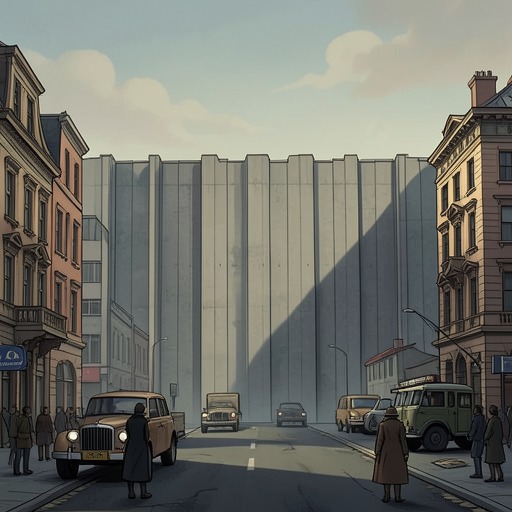
The escape takes place within a divided Berlin whose border is both a physical obstacle and an armed political boundary. The novel’s retrospective account describes the Wall as a symbol of ideology’s violence and recalls the alarm and fear that followed its construction. At Checkpoint Charlie, American and Soviet Bloc tanks faced one another across a short stretch of road, while British, American, French, and West German intelligence networks had failed to foresee the barricades. The new boundary forced surviving agents into more clandestine and perilous forms of work. Against this history, crossing the Wall is never a private journey alone: it means confronting an apparatus built to prevent movement between East and West.
Earlier, Leamas had crossed the sector border in a Mercedes driven through checkpoints under an arrangement that allowed the car to pass. He noticed the Eastern fortifications—observation towers, barbed wire, and anti-vehicle obstacles—as the vehicle continued east. That passage, managed through official-looking movement and timing, contrasts with the final attempt to get out: the Wall’s defenses are no longer a background seen from a car but the immediate test facing Leamas and Liz.
The earlier escape attempt by Karl Riemeck also establishes how quickly a crossing can turn lethal. Karl reached the customs hut and appeared to have passed the checks; the barrier lifted, and he began toward the remaining line between him and safety. Searchlights then exposed him, alarms sounded, and East German guards fired as he rode on. Leamas watched from the other side. The final attempt echoes that earlier scene: a brief prospect of passage gives way to illumination, alarm, and gunfire.
The Attempt and Its Reversal
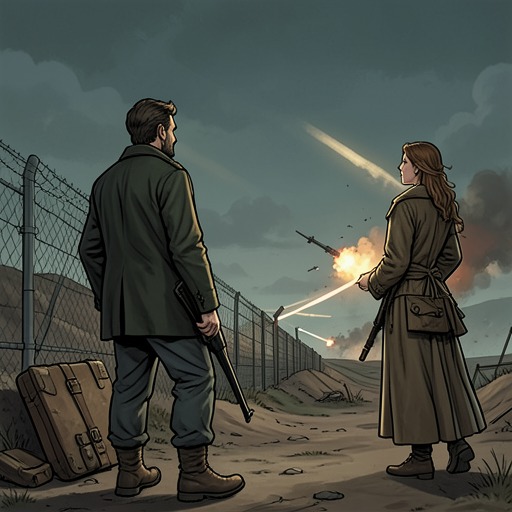
At the Wall, alarms and shouted orders break into the escape. Leamas is half astride the barrier, struggling to draw Liz up by her arms. The effort is precarious: he is close to falling himself, but continues pulling her toward him. The sequence makes their shared escape depend on a physical act of mutual assistance, not on the schemes and controlled crossings that have shaped the intelligence plot.
The guards fire several single rounds. Liz shudders, and her arms slip from Leamas’s hands. From the Western side, someone calls, “Jump, Alec! Jump, man!” The command offers him a chance to complete the crossing alone, but it arrives at the moment he has lost his hold on Liz. The escape’s immediate objective—reaching the other side—splits into two choices: save himself, or return to her.
Leamas looks down and sees Liz lying still at the foot of the Wall. He hesitates, then descends by the same rungs and stands beside her. She is dead. Rather than take the opening to jump, he goes back to her; the attempt thus reverses the expected direction of escape. The barrier becomes a line he has crossed only to turn back across, from the prospect of safety toward the person he cannot leave behind.
Deaths and Consequences
After Leamas climbs down, the armed men hesitate before firing again. Then they shoot him. He remains standing briefly, looking around like a blinded bull in an arena, before falling. The scene closes on the deaths of both Leamas and Liz, not on a successful crossing or a rescue. The Western voices and the presence of people on the other side do not alter the outcome.
The ending gives the escape an ethical force that the surrounding intelligence calculations have tried to contain. Leamas has acknowledged that the operation makes him sick with shame and anger, even as he says that it has paid off and that this is the rule by which his side acts. Liz has challenged that reasoning, insisting that the people destroyed by such calculations are not interchangeable. At the Wall, the argument becomes concrete: Liz is dead, and Leamas does not use the final opportunity to save himself without her.
The novel’s earlier account of the Wall calls it both theatre and a symbol of ideological extremity, while noting that escape was rare and that those who succeeded were treated as heroes. This attempt ends otherwise. Its failure exposes the cost hidden by strategic accounts of success: the operation may achieve its political purpose, but the people entangled in it cannot be restored. The Wall remains standing, and the crossing ends in death rather than liberation.